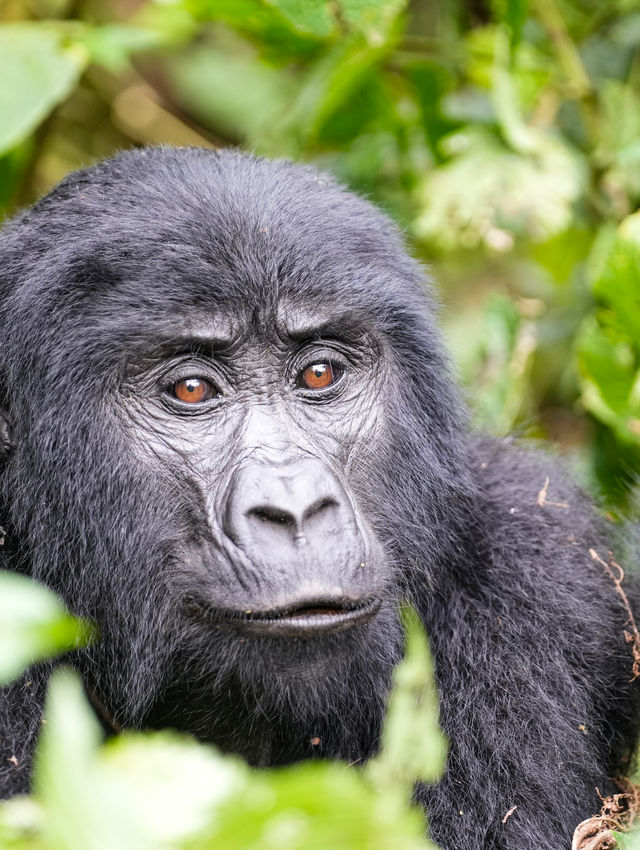
There is a moment, about an hour into the forest, when the guide raises a hand and everyone stops moving. He has heard something the rest of us have not. Then the leaves shift twelve metres ahead, and a silverback the size of a small car sits up and looks at you the way a person would.
We went to Bwindi from Kigali, which is the fastest way to do it, and the whole segment cost us three nights. This is how it worked, what the border crossing is really like, and what that hour with the gorillas is actually like once you are standing in it.
Kigali first, and it surprised us
We flew into Kigali and stayed at the Radisson Blu, before Bwindi and again after. I did not expect to be writing a paragraph about a hotel in Rwanda that outperforms most of what we book in Europe, and yet: the security is serious and unobtrusive, the food is genuinely good, the service is quick and warm. It beat our expectations by a distance, and coming back to the same hotel after the forest made the luggage and the transfers effortless.
Kigali itself deserves more than a stopover. It is clean, calm, green and hilly, one of the easiest African capitals to walk around, and the light in the late afternoon is beautiful. If you can add a day at the beginning, add it here.
The border crossing: the part nobody warns you about
This is the single most important logistical thing in this piece, so I will be blunt: a car you rent in Rwanda is not automatically allowed to enter Uganda. Ours needed a whole file of things before it could cross.
- An authorised driver — self-drive across the border was not an option for us
- A cross-border permit issued by the rental company
- COMESA insurance, the regional cover that makes the car legal in Uganda
- A supplement for the driver's own overnight stay
- Paperwork completed at the rental company's office before departure, not at the border
Even with all of it in order, the crossing itself was complicated: forms, queues, checks on both sides, and a lot of waiting in a place where nothing is signposted for a foreigner. Budget far more time than the distance suggests, and do not plan anything tight on the other side.
What made the day was the drive. Our driver talked for hours — about the hills, the terraced farming that climbs every slope in Rwanda, the country's rules and how recent they are, the tea and coffee that grow along the road, the villages we passed. You do not get that from a steering wheel and a map. If there is one argument for taking a driver beyond the paperwork, it is this one: on that road, the explanation is half the journey.
Arriving at the edge of the Impenetrable Forest
Then the forest appears, and the name stops being a name. Bwindi Impenetrable Forest is exactly that: a wall of green so dense you cannot see three metres into it, spilling over the hills in every direction.


We climbed the last stretch with the jeep up the side of a mountain, on a track that turns and turns, and at the top the view opens over the whole valley. Forest to the horizon, mist sitting in the folds, and the feeling — completely new to us — of being properly, geographically in the middle of Africa. It is one of the landscapes I will not forget.
Rushaga Gorilla Lodge, and why the sector matters
We slept at the Rushaga Gorilla Lodge, in the Rushaga sector on the southern side of Bwindi, in a Deluxe Cottage on full board. The view from the room and from the lodge terrace is spectacular: the cottages look straight out over the forested valley, and in the morning the mist comes up out of it while you have breakfast.
Full board is the sensible choice here rather than an indulgence: the area is remote, there is nothing else within reach, and the departure the next morning is very early.
The thing to understand before booking anything: Bwindi is divided into sectors — Rushaga, Nkuringo, Buhoma, Ruhija — and your permit is issued for one specific sector. Booking "a hotel near Bwindi" is not enough. The sectors are hours apart on mountain roads, and sleeping in the wrong one can mean missing the briefing entirely. Our permit was for Rushaga, so we slept at Rushaga. A detail that helped: the trekking voucher was collected at the lodge reception, which removes the risk of turning up to the briefing without the right document.
The morning: briefing, then into the jungle
It starts early and it starts with paperwork: passports are checked, then a ranger gives the briefing — how to behave, how far to stay back, what to do if a gorilla approaches you, which is a real question and not a hypothetical one.
Then you are assigned a family and a guide, and you go in with a small group. That is the design rather than luck: only eight people a day are allowed to visit each habituated family, which is why the permits are so limited and so expensive. We walked for about an hour, a gentle trek through the jungle rather than a climb, and the walk itself is worth the price of entry — the vegetation, the light coming down in pieces, the sound.

And then the guide stopped, listened, and found them. Trackers go out ahead at dawn to locate each family, which is why an hour of walking is normal and five is also normal: it depends entirely on where the gorillas slept.
One hour, a few metres away
You get one hour. It is the rule, it is strictly kept, and it is both very short and completely sufficient.
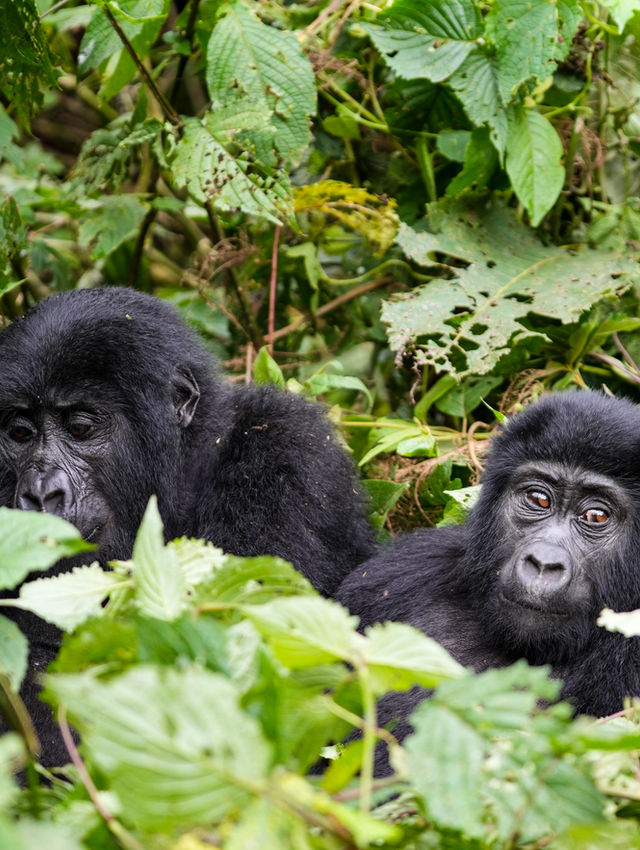
The family was right there, a few metres from us, entirely uninterested in our presence. The adults were eating, methodically, pulling down leaves and stems with hands that are unnervingly like ours. The young ones were playing — rolling, climbing, falling off things, coming back to try again — and one of them came close enough that the guide moved us gently backwards.

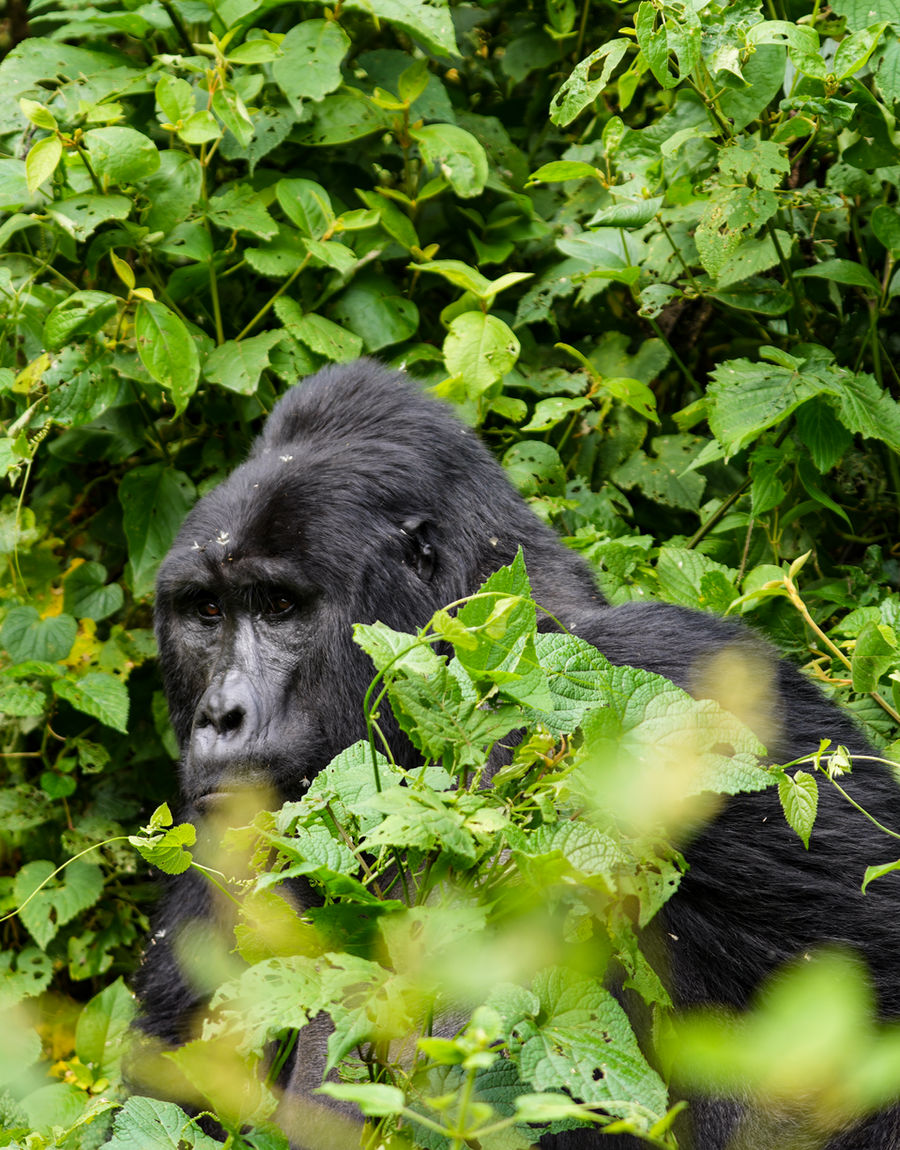
What stays with you is not the size, although the silverback is enormous. It is the ordinariness of it: a family having a normal morning while eight strangers watch. Nobody speaks. An hour goes past like ten minutes.


They eat almost continuously — a grown gorilla puts away something like twenty kilos of leaves, stems and shoots a day — and they do it sitting down, unhurried, stripping a branch with a thumb the way you would shell a pea.


The faces are the part no photograph quite prepares you for. Each one is individual enough that the trackers know every animal by sight, and the expressions land somewhere uncomfortably familiar: bored, curious, patient, briefly annoyed with a child.
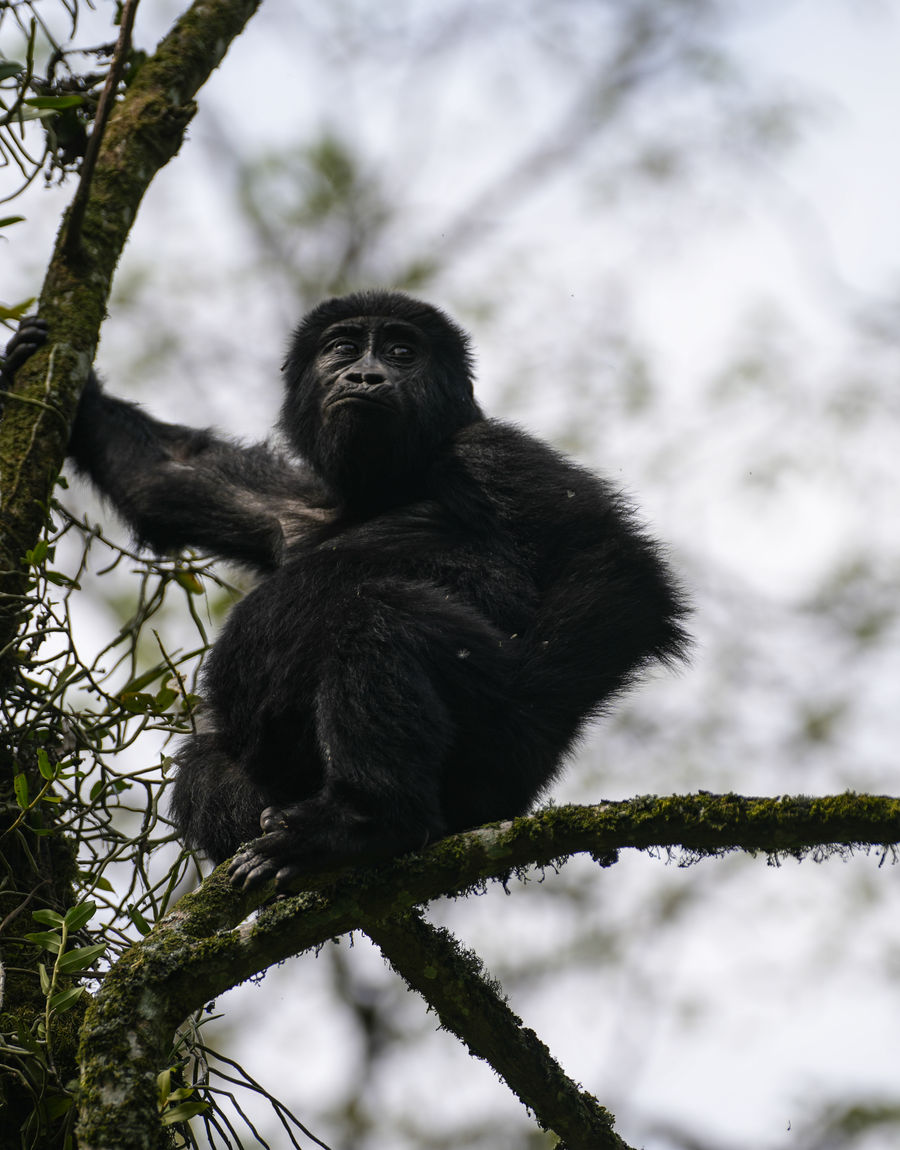

The young ones spent our hour testing what would hold their weight. One of them climbed the same thin trunk three times, fell off twice, and went back up without any apparent embarrassment while its mother ate two metres away and did not look up once.


The gorillas, and why the rules are so tight
Mountain gorillas are among the rarest animals on earth. There are roughly a thousand left in the world, all of them in a small area straddling Uganda, Rwanda and the Democratic Republic of Congo, and Bwindi alone holds around half of them. They came back from a few hundred, and they came back precisely because access was restricted, priced and policed.
- Eight visitors per family per day, one hour only
- A minimum distance from the animals, and no visit at all if you are ill — they catch what we catch
- The permit money funds the rangers, the trackers and the communities around the park
- Uganda issues around 150 permits a day across four sectors and about nineteen habituated families
The permits are limited and they sell out. Uganda's gorilla permit costs $800 per person for the standard one-hour trek, and there is a habituation experience in Rushaga that costs $1,500 and gives you four hours with a semi-habituated family. Book months ahead — in high season, considerably more than months — and only then book flights and lodges around the date you get.
The route, in three nights
Our whole Rwanda–Uganda segment fitted into three nights, which is worth knowing if your time is short:
- Day 1: fly into Kigali, night at the Radisson Blu
- Day 2: road transfer to Bwindi with a driver, border crossing, night at Rushaga Gorilla Lodge on full board
- Day 3: gorilla trekking in the morning, drive back to Kigali, second night at the Radisson Blu
- Day 4: fly on — in our case Kigali to Seronera, into the Serengeti
It works, and it is efficient. But it leaves almost no margin: one delay at the border, one problem with the car, one trek that runs long, and the whole chain wobbles. If you can afford one extra night, put it in Kigali on the way back.
What I would tell you before you go
- Book the permit first, everything else second. The date of the permit is the trip
- Sleep in the sector your permit is issued for — not simply "near Bwindi"
- Take the driver, and take the paperwork seriously: cross-border permit and COMESA insurance are not optional
- Carry your passport on the trek: it is checked at the briefing
- Full board at the lodge, because there is nothing else out there and the start is early
- Gloves, long sleeves, boots with grip: it is called Impenetrable for a reason, and the ground is wet
- Do not go if you are unwell. A cold is dangerous to them, and the rangers will and should turn you away
Conclusions
This is one of those experiences that resets the scale of things. We had spent the previous months planning a trip and the previous day arguing with a border, and then we sat in a forest and watched a family of animals be a family, at arm's length, for sixty minutes.
It is expensive, it is complicated, it takes three days to give you one hour — and it is the single thing I would tell anyone to do once in their life. Kigali surprised us, the drive gave us a country, the forest gave us a view we still talk about. The gorillas gave us the hour.